
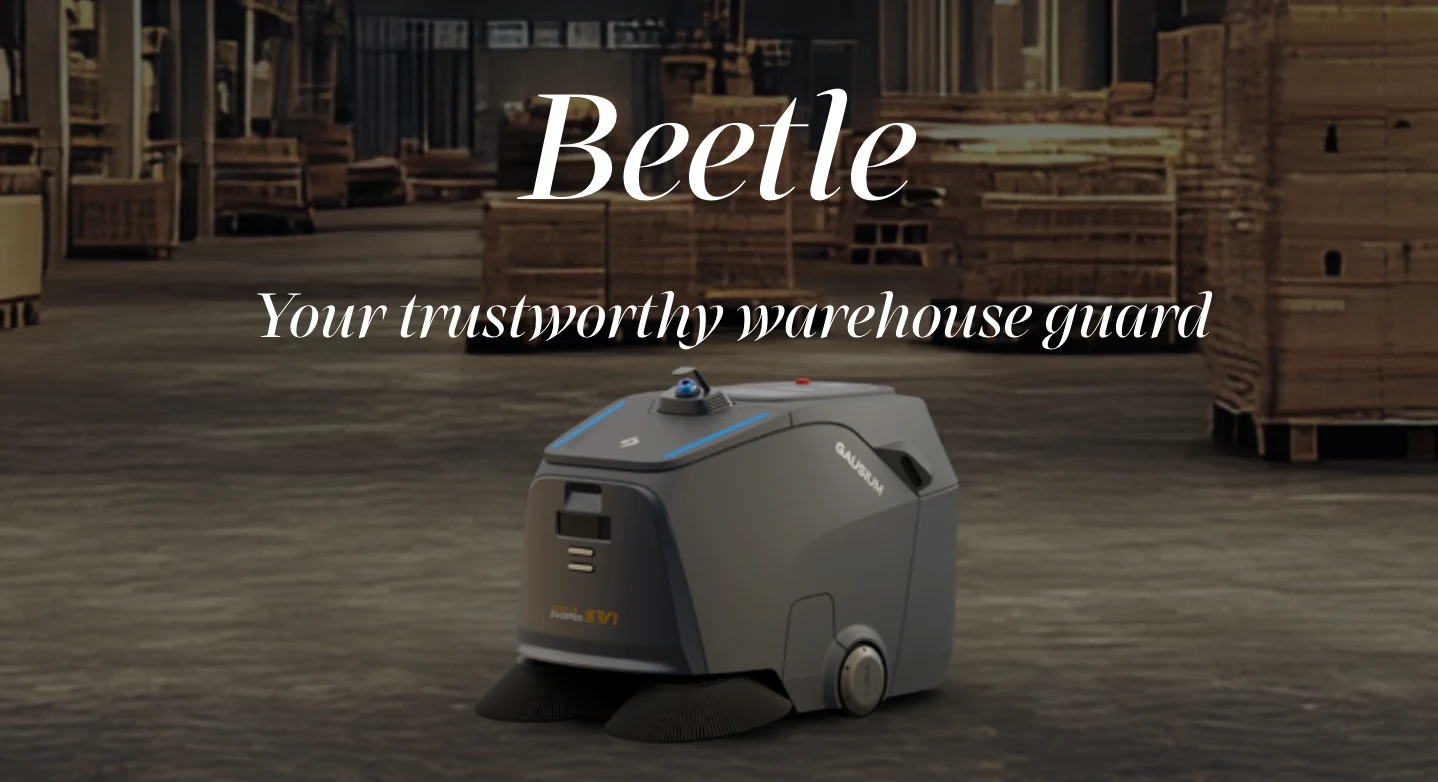
How does Gausium Beetle clean industrial floors? Two side brushes gather loose debris into the path of a central roller brush. The roller lifts debris into the collection system, while vacuum airflow and HEPA filtration help control fine dust. This guide explains the components, specifications and maintenance considerations for Australian warehouses and factories.
Warehouse and factory floors produce a mix of debris that no single cleaning method handles well. Fine dust and sand, timber splinters off pallets, strapping, torn cardboard, paper, dropped screws and metal swarf, and dry food waste in production areas. The areas involved are large, and the debris arrives continuously rather than in one predictable place.
What decides how well an autonomous sweeper performs in that environment is not really whether it can drive itself. It is whether the chassis, the brush layout, the vacuum system and the waste collection method form a complete path that takes debris off the floor and keeps it off.
The Gausium Beetle industrial sweeping robot combines side brushes, a central roller brush, vacuum-assisted dust capture, HEPA filtration and a detachable waste bin. Together, these components gather dry debris, lift it from the floor and retain collected material inside the machine.
Gausium Beetle chassis: the main components
From the outside the Beetle is a compact machine. The underside carries several components that only make sense as a set.
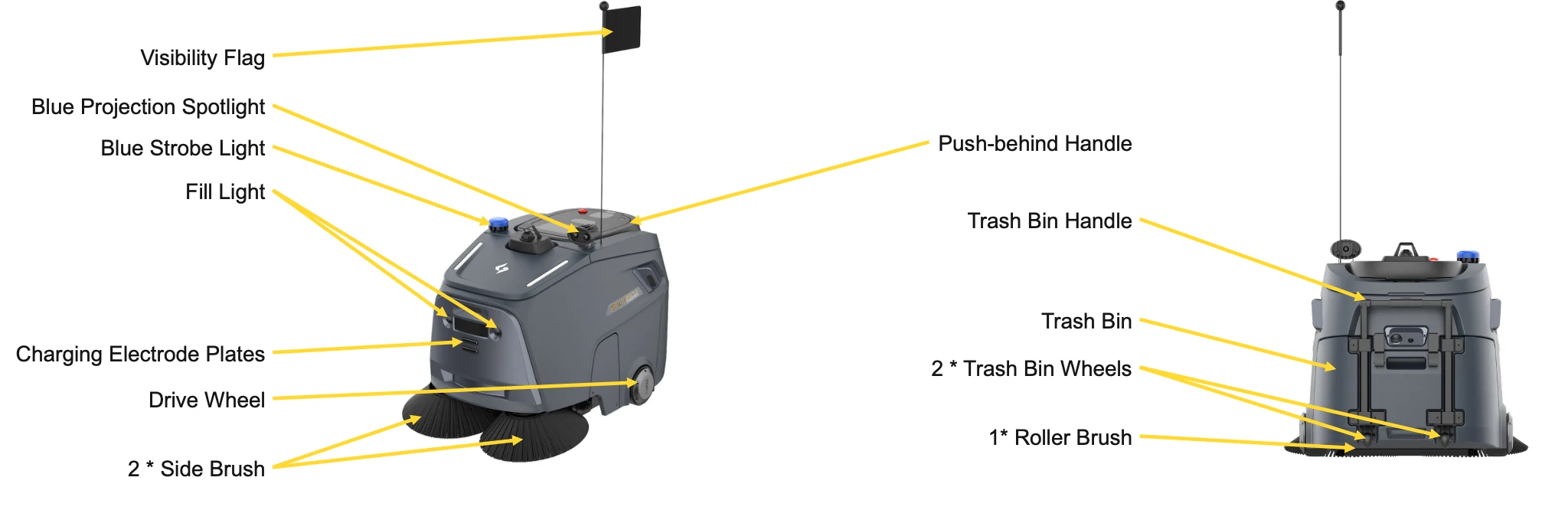
- Two side brushes
- One central roller brush
- Drive wheels
- A 45 L detachable trash bin, mounted on its own castors
- Vacuum system
- HEPA filtration
- Charging contacts
- A push handle for manual repositioning
The components that move debris off the floor and into the machine are the two side brushes and the single roller brush. Each side brush measures approximately 400 mm in diameter, giving a total sweeping width of 750 mm. The central roller brush works a 400 mm path.
Those brushes are not simply bolted to the underside in the hope of covering more ground. They do two different jobs.
How Beetle side brushes clean warehouse edges
Debris in an industrial building does not conveniently gather in front of the machine. It collects against walls, along the base of racking, around columns, beside equipment, and down both sides of a traffic aisle. All those positions sit outside the reach of a central roller brush.
The Beetle carries two rotating side brushes ahead of the chassis. As the machine advances, the brushes sweep debris inward from either side and from the area directly in front, delivering it into the central cleaning zone.
Side brushes gather. The roller brush collects. That division is why the Beetle can clean edge to edge, and Gausium publishes a minimum wall cleaning distance of 0 mm.
How the central roller brush collects industrial debris
Once debris has been gathered into the centre, the roller brush takes over. It runs at up to 800 rpm from a 150 W motor, lifting material off the floor surface and carrying it into the machine.
The speed matters because of the range of material involved. Light debris such as paper, plastic bags, packaging film and wood shavings behaves very differently from harder items like screws, nuts, metal fragments and dried food waste. Gausium lists all of these among the debris types the Beetle is designed to pick up, along with plastic bottles, disposable cups and crumpled paper.
Vacuum and HEPA filtration for warehouse dust control
Brushes on their own deal with the debris you can see. The problem is what they do to the debris you cannot. Mechanical sweeping lifts fine dust into the air, which then settles again once the machine has passed.
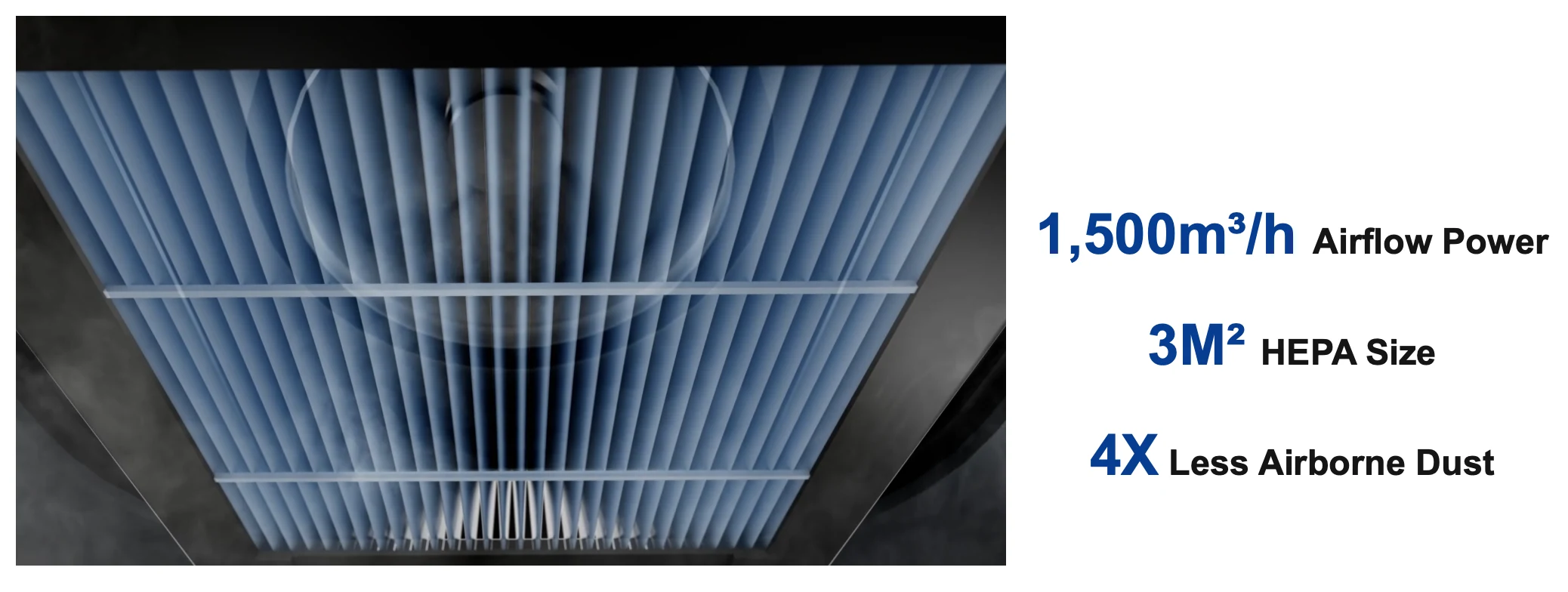
The Beetle runs a vacuum system alongside the brushes, with a maximum air flow of 1,500 m³/h drawn through approximately 3 m² of HEPA filter media. The cleaning path is therefore not brushes, then debris left on the floor. It is brushes, then debris into the machine, then airborne dust captured by the airflow, then filtration, then clean air out.
In a warehouse or production facility this matters beyond floor appearance. Industrial dust settles on stock and equipment, and it stays in the air that people work in. Controlling it at the point of sweeping is more effective than dealing with it afterwards.
The 45-litre detachable waste bin
The Beetle collects swept debris in a detachable 45 L bin, while its filtration system captures fine dust from the airflow.
The bin is designed to be removed rather than emptied in place, which spares staff from crouching under the chassis. Release, pull out, wheel it to the waste area, tip, and refit. Its own castors mean the full bin is rolled rather than carried, which reduces the need to lift and carry collected waste.
How the Beetle industrial sweeping robot works: six steps
- Side brushes gather. The machine advances, and the two rotating side brushes sweep debris from the edges and the area ahead into the centre.
- Roller brush collects. The central roller brush turns at speed, lifting debris off the floor and carrying it into the machine.
- Vacuum draws. The suction motor generates airflow that pulls fine dust into the internal filtration system before it can resettle.
- HEPA filters. A large filter area captures fine particulate, reducing the airborne dust that sweeping would otherwise create.
- Bin stores. Swept debris accumulates in the detachable 45 L container.
- Bin is wheeled out. When it fills, the bin detaches and rolls to the waste point on its own castors.
Sweep, collect, vacuum, filter, store. Each stage depends on the one before it, which is why the chassis is better understood as a system than as a set of parts.
Why choose an autonomous sweeper for warehouses and factories?
Gausium lists warehouses, logistics hubs, factories, hotels, public spaces and campuses as the Beetle’s intended environments, and it is built for large-area dry sweeping rather than domestic or light commercial floors.
Those sites share a particular combination: substantial floor area, a wide mix of debris types, a high required cleaning frequency, and manual sweeping costs that scale directly with all three.
The headline figures behind that are a 750 mm sweeping width, a maximum theoretical efficiency of 3,240 m²/h, a 45 L bin, up to 1,500 m³/h of airflow, around 3 m² of HEPA media, and a maximum moving speed of 1.2 m/s. Runtime is three hours on the Standard version and five on the Pro, with charging under two and a half hours.
One feature of the Pro version deserves more attention than it usually gets in an industrial setting. It adds a visibility flag, a strobe light and headlights, which exist so that a forklift driver sees the machine before they need to react to it. In a building with vehicle traffic, being seen is a safety specification rather than a convenience.
Beetle dimensions, aisle clearance and turning space
Larger is not automatically better for an industrial sweeper. Warehouses contain racking, columns, equipment, pedestrian routes and moving forklifts, and a machine that cannot get through an aisle cleans nothing in it.
The Beetle measures 960 × 650 × 680 mm without side brushes fitted, and 990 × 750 × 680 mm with them. With side brushes fitted, the machine is 750 mm wide; operating clearance should be confirmed during a site assessment. Approximately 1,200 mm of space is required to complete a U-turn, and it handles gradients up to 8°.
The chassis is therefore a balance. Brushes wide enough to cover useful ground per pass, on a body compact enough to reach the aisles and confined areas where debris actually collects.
Autonomous navigation and obstacle detection
The cleaning system answers how the floor gets cleaned. Navigation answers where.
The Beetle Pro carries 3D LiDAR, a forward-facing angled RGB-D camera, and RGB cameras covering the rear and both sides. It supports obstacle detection, anti-drop detection, detection of overhanging obstacles, and detection of moving obstacles.
In practice the machine is not repeating a fixed route. It senses its surroundings and works with its navigation system to complete a cleaning task, adapting to what is actually in the building that night. That capability is the main line separating an autonomous industrial sweeper from a conventional walk-behind machine.
Beetle maintenance: side brushes, roller brush and bin
Whether a sweeping robot runs reliably over years depends as much on routine maintenance as on the original hardware design, and the Beetle’s main cleaning components are built to come apart easily.
The side brushes use a detachable magnetic mount. They lift off in seconds for clearing wrapped hair, plastic bags and other debris, and click back on.
The roller brush slides out from the side. Anything wound around it, typically hair, plastic strapping or packaging tape, can be cut away with the brush out of the machine.
The trash bin detaches and rolls, as above.
Side brush, roller brush, trash bin. Checking those three areas on a regular schedule covers most of what keeps a sweeping system working as designed.
How to compare industrial sweeping robots
Autonomy is the feature that gets noticed first and tells you the least. Most machines in this class drive themselves competently, and a ten minute demonstration will not separate them.
The questions that determine performance on a real floor are mechanical. How does the machine gather debris from edges and corners rather than only from directly ahead. What does it do with the dust that sweeping puts into the air. Where does the collected waste go, and how long does it take a staff member to deal with it. How quickly do the wearing parts come off for cleaning.
Read the Beetle’s chassis against those questions and it is not a set of wheels with brushes attached. It is mechanical sweeping, airflow extraction, HEPA filtration, sealed collection and autonomous navigation working as one path from the floor to the bin.
Gausium Beetle specifications
| Specification | Gausium Beetle |
|---|---|
| Sweeping width | 750 mm |
| Maximum theoretical efficiency | 3,240 m²/h |
| Edge cleaning distance | 0 mm |
| Maximum air flow | 1,500 m³/h |
| Trash bin | 45 L, detachable, castor-mounted |
| Maximum moving speed | 1.2 m/s |
| Gradeability | 8° |
| Minimum U-turn width | 1,200 mm |
| Dimensions (without side brushes or flag) | 960 × 650 × 680 mm |
| Dimensions (with side brushes, without flag) | 990 × 750 × 680 mm |
| Runtime | 3 h (Standard) · 5 h (Pro) |
| Charging time | Under 2.5 h |
| Weight | 102 kg (Standard) · 112 kg (Pro) |
| Sensing | 3D LiDAR, RGB camera, RGB-D camera |
| Pro safety features | Visibility flag, strobe light, headlights |
Figures from Gausium published Beetle specifications and Gausium Beetle product documentation. Specifications vary by version and are subject to change; confirm against the current product page before purchase.
Maximum efficiency is theoretical. Actual coverage depends on layout, obstacles, debris, route settings and servicing time. Specifications vary by version. Sources: Gausium Beetle specifications and Gausium Beetle product information.
See Beetle working in an Australian warehouse
Read our Sydney 3PL warehouse deployment case, explore autonomous warehouse cleaning solutions, or view the Gausium Beetle product page.